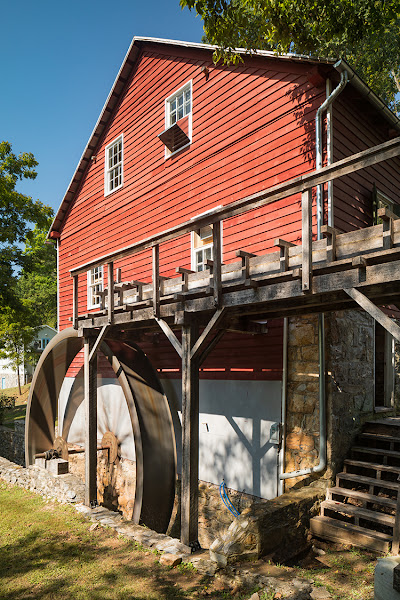
From the 18th century to today, Locke’s Mill is a leader in innovation.
Locke’s Mill is a legacy of Clarke County’s rural milling industry, which flourished as a result of reliable transportation via the Shenandoah River as well as agriculturally rich limestone soils.
The first mill on this property is thought to have been built in the 18th century by Robert Carter Nicholas, grandson of Robert “King” Carter. A 1777 record lists two mills on the site: an Upper Mill and a Lower Mill. One ground oats and Indian corn and the other ground rye and wheat.
In 1876, the present structure was built by Joseph and Mary Price, incorporating a “continuous milling” system that relied on elevators, pulleys and augers to move grains and flour through the mill, eliminating the need for manual labor.
Locke’s Mill was active until 1935, when flooding heavily damaged the mill and production ceased. Repeated flooding, combined with advances in milling technology, rendered Locke’s Mill inoperable for nearly 60 years.
In 1992, the mill was purchased by Jon and Carol Joyce, who spent the next 20-plus years restoring the mill.
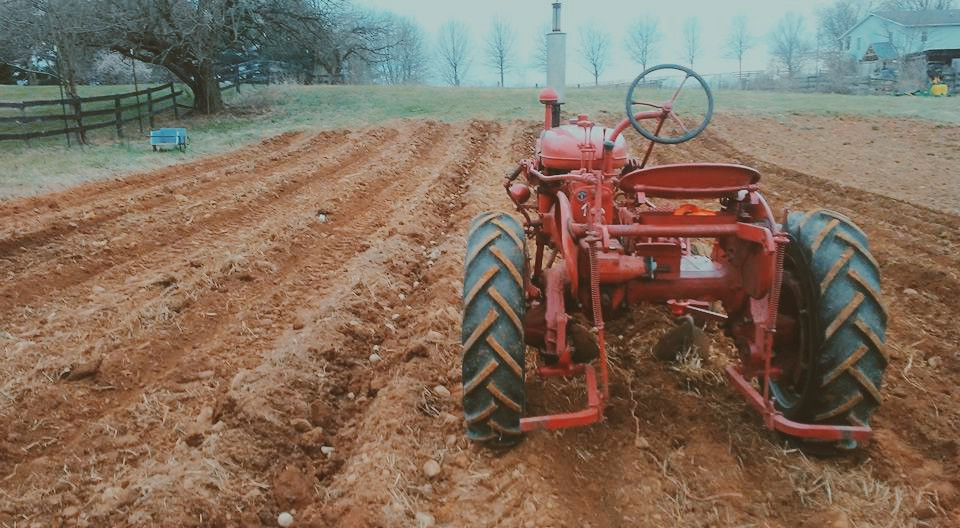
The partially restored mill was purchased in 2016 by Sandy Lerner and a USDA Certified Organic milling system was completed in 2017. Today, Locke’s Mill maintains a two-and-a-half-century tradition of local milling, providing custom grinding services for local distillers, bakers, restaurants, and other customers.
A 1793 map by John Mausey shows Locke's Mill and George Washington's land across the river.
A 1834 survey map shows subdivisions of George Washington's Parcel and Holker's Mill and Holker's Mansion (later Locke's Mill).
A 1864 survey map shows only Shephard's Mill.
Locke’s Mill is shown circa 1920.
1740:Robert Carter Nicholas, grandson of Robert “King” Carter, received approximately 6,000 acres as a part of the 1740 grant distributing Carter’s estate to his heirs. Nicholas was a noted lawyer, a High Court of Chancery Judge, and Treasurer, Burgess, and Delegate of Virginia, James, City County. Upon his death in 1780, he conveyed approximately 3,000 acres to Col. Fieldling Lewis of Kenmore Estate in Fredricksburg, Virginia.
1780:Col. Fieldling Lewismarried Betty Washington, the sister of George Washington, as his second wife. At his death, Lewis willed his Nicholas portion to his three sons, Lawrence, Fielding Jr., and George Lewis.
George Lewis, a nephew of George Washington, served in the Revolutionary War. He married Catherine Daingerfield in 1779, settling in Berryville, Clarke County, Virginia. In 1790, Lewis sold the property to Thomas Colston and George Stubblefield. The deed cites a John Mausey survey of November 21, 1751, showing the mill as operational. At the Kenmore Museum, a mill accounts book, dated 17 January 1777, shows the name of Lewis and indicates that there were two mills on the site: the Upper Mill and a Lower Mill. One ground oats and Indian corn and the other ground rye and wheat. There is evidence of the lower mill’s foundation visible at the present mill site. A later map of Mausey’s, dated 1793, shows one building and George Washington’s land directly across the river.
Charles McCormick, a Clarke County businessman, purchased the property from the Holker family. The largest landowner in Clarke County, he willed the property to his brothers, Francis, Province, and Dr. Cyrus McCormick. The latter willed his portion to the others and Thomas Mc Cormick. Cyrus McCormick’s niece Nannie received the portion with Locke’s Mill and 260 acres. Interestingly, the 1864 map only shows Shephard’s Mill slightly up-river from the position of Locke’s Mill. As the map only superficially covers this area, it may have been unintentionally overlooked, or the mill might have been derelict through this period of the Civil War. This may be the reason why the Price family had to rebuild in 1876…
1876:Joseph and Mary Pricerebuilt the mill, when it became known as Price’s Mill. They operated the mill until 1