









🥩
Meat & Poultry
3Pasture-Raised PorkChopsMeat
🥛
Dairy
1Dairy
🥬
Produce
6ArtichokesButternut SquashParsnipsProduceShallotsShiitake Mushrooms
🍓
Fruit & Berries
7BerriesCitrusFigsFruitLemonsOrangesPersimmons
Not verified by Bhumi. This farm's practices have not been independently verified. Product claims are based on publicly available information and have not been confirmed.
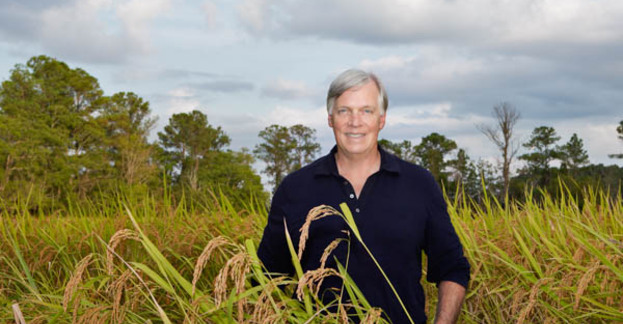
Anson Mills founder Glenn Roberts grew up in San Diego, California, the son of a professional singer and photographer, and a former Southern belle from Edisto, South Carolina who became an accomplished scratch cook and occasional restaurateur. Glenn was a restless, curious boy, who, by all accounts, required steady discipline to stay out of mischief. His mother tried to tame him by putting him to work on weekends as a busboy in her restaurant. His father taught him to fly an Aeronca Champ when he was eight years old, using pillows to prop him up and two-by-fours wired to the rudder pedals. His parents required their children to have musical training: Glenn studied French horn throughout his boyhood and adolescence, performing first in the San Diego Youth Symphony, and later occupying fourth chair in the San Diego Symphony. None of this, however, prevented him from pursuing his real passion: chemistry experiments. Working with explosive gas for a national science contest, Glenn blew the door off his parents’ garage on one occasion and decimated his mother’s kitchen on another. At 17, Glenn entered the University of North Carolina at Chapel Hill on a music and science scholarship and graduated four years later. A conventional life track, however, was too narrow to contain his energies: he joined the Air Force to feed his love of flying, and later sailed around the world on private yachts as a navigator and a mate. He took up riding and dressage. He drove long-haul trucks. Somewhere along the road of diversionary adventure, Glenn’s overarching interests distilled into the study of architectural history and the history of food. Settling down into a suit and proper shoes, he backed into historic property restoration through the kitchen, working on space design and adaptive reuse in Virginia, the Carolinas, and Georgia. His geographic area ultimately narrowed to South Carolina where Glenn took on broader aspects of redesign projects, carrying those through to the hiring of chefs and marketing staff, and to the planning and execution of celebratory dinners at projects’ end. The menus he helped plan were intended to offer period-authentic dishes. But the ingredients didn’t exist. Local growers did not produce them and would not be persuaded to try. In particular, grains of the era like Carolina Gold rice, linchpin of Carolina cuisine, were nearly impossible to source. Glenn’s career epiphany came on a hot summer afternoon in the kitchen of an historic Charleston property. An elaborate rice dinner just hours away, a grower in Savannah—the sole source for Carolina Gold rice—delivered a bag of rice writhing with weevils. At 7 o’clock in the evening, Glenn found himself at a prep table with two dishwashers, sweating in his suit and tie, and rousting weevils from Carolina Gold—the dinner swirling by without him. He thought of his mother’s cooking when he was a boy. He looked at the lousy rice. He vowed to put Carolina Gold into serious production so this would not happen again. For the next several years, Glenn grew small-plot Carolina Gold in Charleston and worked with a rice geneticist in Texas to reinvigorate the seed, which, through neglect and inactivity, had begun to display characteristics of its sister rice, Carolina White. To support his experiments in Carolina Gold, whose resurrection now represented an all-consuming preoccupation, he began to research other regional heirloom grains of the era he could move more quickly into production. The research began with corn. In 1995, Glenn explored rural back roads looking for the famous white Carolina mill corn that was revered for its high mineral and floral characteristics and its creamy mouthfeel. He found this corn in a bootlegger’s field near Dillon, South Carolina in 1997 and planted and harvested his own first crop of 30 acres in 1998. Known as Carolina Gourdseed White, the single-family hand-select dated back to the late 1600s. Glenn passed Gourdseed grits around to chefs in
Meet Glenn Roberts
Farm Owner