Cattle Ranch
wheretexasbecametexas.org
On March 2, 1836, 59 delegates from all parts of the Texas settlement bravely met at Washington, Texas to make a formal declaration of independence from Mexico, proclaiming to the world that Texas was a sovereign nation. Revered as the place “Where Texas Became Texas,” the replica of Independence Hall on the Washington on the Brazos State Historic Site grounds marks the very place where the government of the Republic of Texas was created and proudly existed in 1836 and again from 1842-1845. The delegates meeting in convention periodically received letters from the Alamo while it was under siege, leading to heated discussions about what the delegates’ duty should be. When a delegate moved that the convention put its business on hold and ride to the defense of the Alamo, Texas Army General and delegate Sam Houston insisted that the meeting continue. He pointed out that without both a declaration and a constitution, Texans would be considered “nothing but outlaws, and can hope neither for the sympathy nor respect of mankind.” William Barret Travis, in a letter that was received in Washington on the day the Alamo fell, reiterated his determination to fight to the death. On the second page of the letter, Travis threatened convention delegates to finish their work, saying, “ …let the convention go on and make a declaration of independence and we will then understand and the world will understand what we are fighting for. If independence is not declared, I shall lay down my arms and so shall the men under my command.” The delegates finished their work as Santa Anna and his army marched eastward, hell-bent on capturing the political leaders of the rebellion. The work the delegates accomplished before abandoning Washington changed the world forever. While little remains of Old Washington, the spirit of those early freedom-seeking Texans pervades the park and its programs, allowing visitors to experience life before and during the Republic era. Sixty years after the United States signed its Declaration of Independence at Independence Hall in Philadelphia, Independence Hall at Washington on the Brazos State Historic Site is the place Where Texas Became Texas and we signed our own Declaration of Independence from Mexico. Take a step back into the 1850s. Join costumed staff and experience a day in the life of the Jones family as you experience daily activities such as gardening, cooking at an open hearth, and caring for the different breeds of livestock. Explore the life and original home of Dr. Anson Jones, the last president of the Republic of Texas. The Museum inspires interest, understanding and appreciation of Texas heritage for students, teachers, scholars, and the general public through interactive exhibits, tours, programs, web activities and outreach. Nestled amid the rolling hills of Grimes County in Anderson, Texas, about 20 miles northwest of Washington on the Brazos, Fanthorp Inn stands as a wonderfully preserved example of a 19th century stagecoach inn. The Visitor Center & Gift Shop features interactive exhibits in the Gallery of the Republic which present a timeline of the Texas Revolution and highlights the historic attractions of the park. With picturesque views of the Brazos Valley, the Conference Center, the Overlook Room, and the adjoining patio are perfect spaces for meetings, weddings and reunions. Washington on the Brazos Historical Foundation, a non-profit 501(c)3 organization, exists to help preserve the rich history of the heroic actions taken by our forefathers at Washington on the Brazos with the signing of the Texas Declaration of Independence from Mexico on March 2, 1836. The Foundation raises funds to facilitate programs, celebrations, and education at Washington on the Brazos State Historic Site, Star of the Republic Museum, Independence Hall, Barrington Plantation and Fanthorp Inn. You can play a vital role in Texas History, join the Foundation today! 23400 Park Road 12 Washington, Texas 77880 936
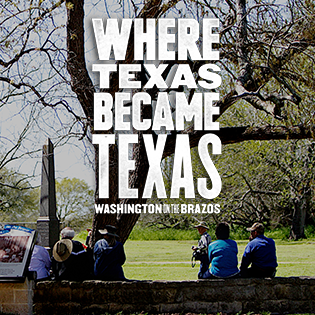
For Texans, Independence Hall is one of our most significant historic sites. It was here, in the raw frontier town of Washington in 1836, 59 men elected from municipalities across the territory met in an unfinished frame building to determine the fate of this vast land we call Texas! Meanwhile, the forces of General Santa Anna laid siege to the Alamo. “Fellow-Citizens of Texas: The enemy are upon us. A strong force surrounds the walls of the Alamo, and threaten that garrison with the sword…Now is the day, and now is the hour, when Texas expects every man to do his duty. Let us show ourselves worthy to be free and we shall be free.”Henry Smith, Washington, TX – March 2, 1836 Even as the settlers fled ahead of Santa Anna’s army, the convention labored for 17 days. During that time they declared Texas independent from Mexico; penned a new constitution; and organized an interim government, giving birth to a new nation: the Republic of Texas. Today, Washington on the Brazos State Historic Site takes great care to preserve the sanctity of this shrine to the Texas spirit for the many generations of Texans yet to come. Independence Hall marks the birthplace of Texas independence. The current building, a 1970 replica by Raiford Stripling, stands on the original site where delegates met in March 1836 to draft the Texas Declaration of Independence. The original hall, built by Noah T. Byars and Peter M. Mercer, was a simple frame structure—unfinished yet historic. Delegates gathered around a long table to shape the future of Texas, while visitors observed from the sidelines. Though demolished in the mid1800s, its memory endured. Pieces of the original building were turned into keepsakes, including a judge’s gavel and a document box known as the “Ark of the Covenant of the Texas Declaration,” now preserved in the Texas State Archives. Independence Hall remains the most documented building in Washington-on-the-Brazos, symbolizing the courage and vision that gave birth to a republic. Sam Houston’s Presidential Office When the Republic of Texas government returned to Washington in 1842, President Sam Houston worked from a modest one-room law office on Main Street. The space was simple—a fireplace, a single table, and a couch where Houston reclined while dictating correspondence to his secretary. Diplomats joked about its lack of glass windows, calling it “rather raw,” yet this humble office became the center of Texas leadership during a critical period. In 1845, the government finally installed glass windows and basic furnishings, but the building never lost its frontier character. Today, it stands as a reminder that great decisions often come from the simplest places. Benjamin F. Rucker’s two-story frame building, dating to the late 1830s, was Washington’s primary pharmacy and a vital part of daily life. Stocked with medicines and goods valued at nearly $5,000 annually, Rucker’s Drugstore served settlers and officials alike during the Republic era. Its presence reflects Washington’s growth from a political hub to a thriving community. Hatfield’s Exchange was more than a saloon—it was a political and social center. Purchased by Basil M. Hatfield in 1839, its upstairs hall hosted sessions of the 8th and 9th Congress and even the inaugural ball of President Anson Jones in 1844. Lawmakers debated above a bustling tavern, and guests danced in a hall where the floor once gave way during festivities. This lively venue illustrates the blend of politics and frontier life in early Texas. Heath’s Carpenter Shop Samuel Heath’s carpentry shop served as lodging for delegates during the 1836 Convention. Leaders like Lorenzo de Zavala and José Antonio Navarro stayed here while Heath crafted tables and benches for Independence Hall. Later, the shop became an office for Secretary of State Anson Jones, showing its adaptability in the young Republic. Heath’s story reflects the essential role of craftsmen in shaping Texas history. Bailey, Gay & Hoxey
Meet Henry Cartmell
Farmers Market Owner · Since 1836
Every practice listed here means something specific. Tap any practice to learn what it requires and why it matters.
Not verified by Bhumi. This farm's practices have not been independently verified. Product claims (grass-fed, pasture-raised, organic, etc.) are based on publicly available information and have not been confirmed.
Practices